授课方式 | 线下
课程类别 | 文化、历史与生态,适合申请景观和景观偏城设方向的同学
项目尺度 | 大、中、小尺度皆可
课前准备 | 课程开课前熟悉Photoshop、Illustrator、Indesign、Rhino的操作应用,了解通过这些软件做图的基本方法。
授课时间 | 2019年8月(暂定)
Studio人数 | 6-12人
注:未签约学员咨询报名前咨询客服主页菌; 已经签约RAC学员可用15节1v1课时+5节助教课时兑换
引言:
“The ultimate significance of heritage preservation is celebrating the glorious existences of themselves. “
---- Amita Sinha
studio背景:
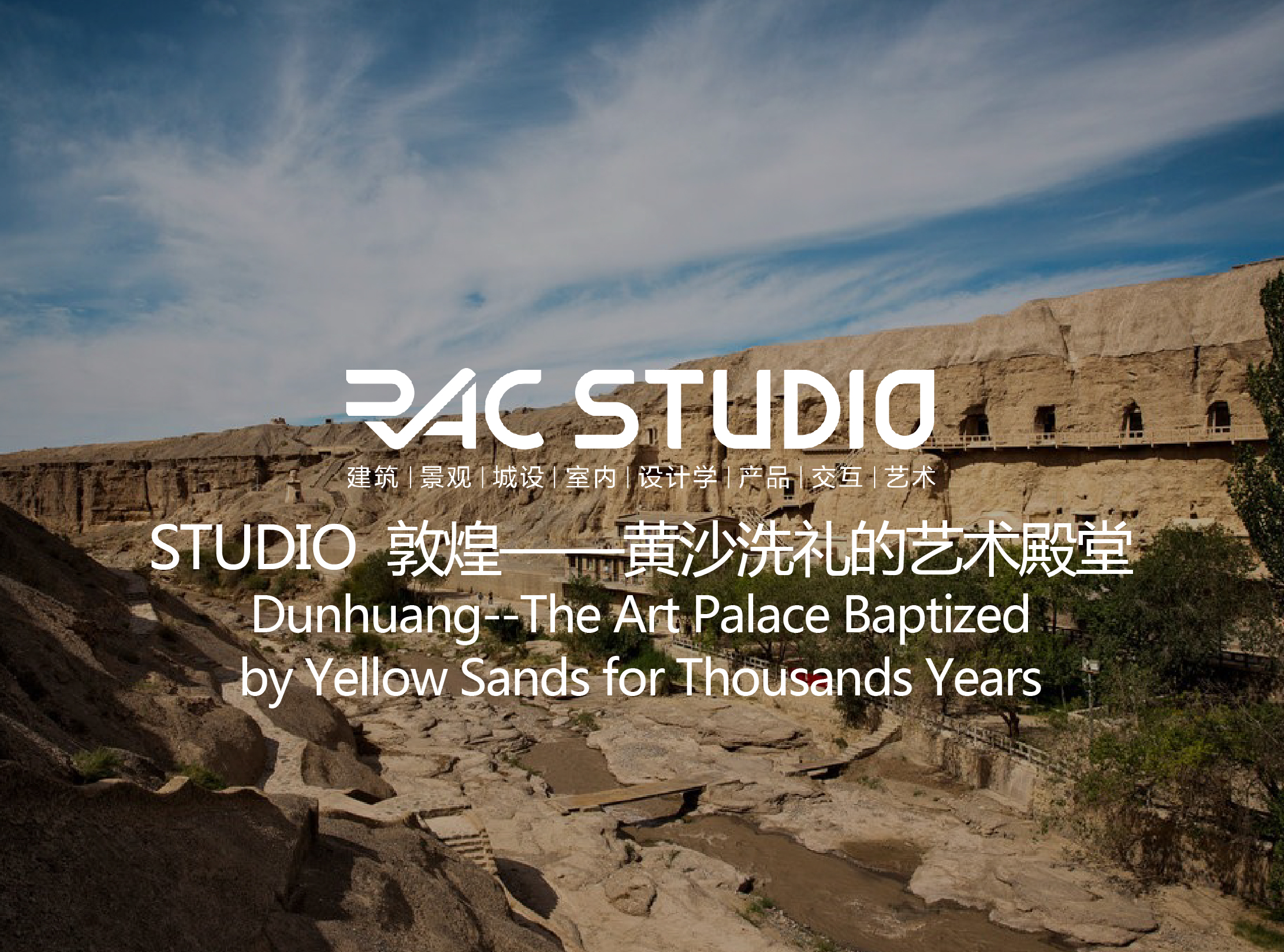
Dunhuang Art CAVE (DAC), which is situated beside the city of Dunhuang, Gansu province, northwest of China. Presently, there exist more than five hundred caves ranging from Sixteen Counties (A.D. 304-439) to Yuan Dynasty (A.D. 1279-1368), which comprise about fifty thousand square meter murals and about three thousand painting sculptures. DAC is one of the most famous cultural heritage sites in the world, and has provided plentiful material for people to research on Chinese ancient art, history, culture and so on. The most important components of DAC are architecture, murals and painting sculptures, which possess not only great artistic value but also profound cultural significance. Therefore, DAC was ranked as a national key culture relic by the State Council of P. R. China in 1961, and was also named as World History and Culture Heritage by UNESCO in 1987.
As located inside the desert area, DAC is confronted with the serious influence of natural efflorescence and disaster. How to preserve, investigate and exploit the cultural heritage is a very important engineering. Presently, the experts of Dunhuang Academy have already carried out a lot of projects, which investigate cultural relic preservation, restoration and reinforcement. These projects involve environment measurement and analysis, mural pigment analysis and pigment fading tests, etc. However, how to fundamentally solve the preservation problems of DAC and speed up the investigation and exploitation of the cultural relics is still a very complicated and significant engineering.

Figure 1/2/3: Kumtag Desert edit by Shunyao Hu
studio场地位置:
甘肃省敦煌 Dunhuang, Gansu Province

Figure 4: Two sits Dunhuang in satellite view. Source: Google maps
Studio目的:
In a cooperative heritage restoration system, people have different contribution to the restoration work. In order to represent this variability, people can take on different roles. The roles describe the behavior of different people in a collaborative restoration system. Some roles may be taken by more than one person; some may only be performed by one. In this studio, we examine landscape designers as parts of contributors. The role sets can be described as chairmen, extractors, preservers, artists, observers.
手法与媒介:
1. 背景研究和分析(Background and Problem Statement)
Data collection, report collection, documents reading: objectively, accurately and authentically understand Dunhuang as a cultural heritage. Define the role of landscape design.
2. 场地调研和分析(Inventory and Analysis)
Within the background of Dunhuang discussed in the problem statement, analysis the specific problem of the site.
3. 概念设计、提出应对方案(Conceptual Design)
Design interactions, experiences, processes and strategies based on the pre-phased analysis.
4. 设计表达(Design Expression)
Use mapping, collage, toolbox, plan, model, etc. to express design in landscape method.
studio成果:
-- Construct a thinking system for complex social and environmental problems.
-- Solve complex problems with landscape language.
1. Mapping/ Collage/Data Visualization
2. Prototype Design/Typology/Toolbox
3. Plan/ Sections
4. Scenario/ Axonometric
5. Renderings
6. Model

Figure 5: By Danika Cooper

Figure 6: By Gary Polk Figure 7: By Yu Ding, Kees Lokman.

Figure 8: By by Carla Lores and Michael Yarisnky Figure 9: By Danika Cooper
参考案例:
1. Dredging Dunes ---- by Yu Ding, Kees Lokman
2. Ambivalent Object VI: Gigantic ---- by Gary Polk
3. A Perpetual Pride ---- by Luke Whitaker
4. Parametric Watershed Landscape in New York City ---- by Carla Lores and Michael Yarisnky
5. Sandstone-making microbes, tafoni ---- by Magnus Larsson
参考书目:
1. McHarg, I. L. (1995). Design With Nature. St. Louis, MO: Turtleback.
2. Potteiger, M., & Purinton, J. (1998). Landscape Narratives: Design Practices for Telling Stories. Hoboken, NJ: John Wiley & Sons.
3. Ward, E. Neville,Killham, Bet. (1987) Heritage conservation :the natural environment Waterloo, Ont. : Heritage Resources Centre, University of Waterloo.
4. 《敦煌市城市总体规划(2008—2020年)》
5. 《藏经洞打开了百年悲欢》