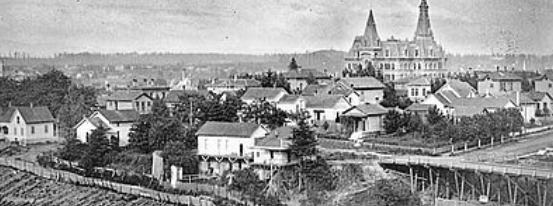
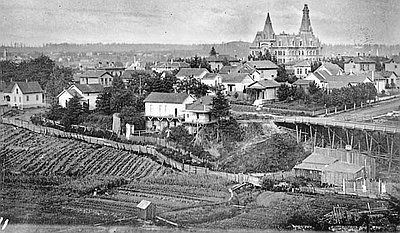
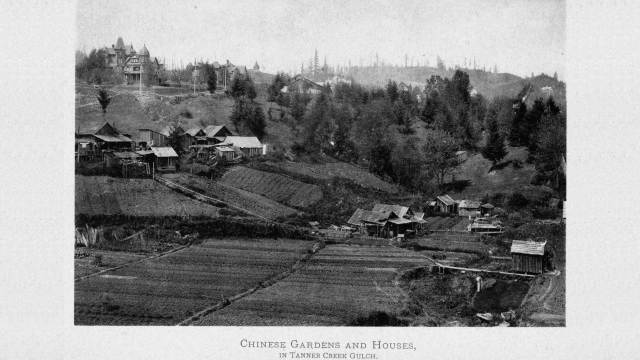
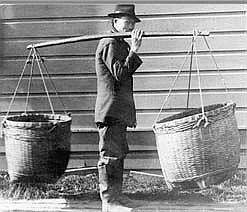
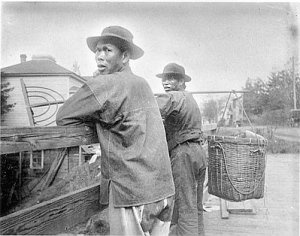
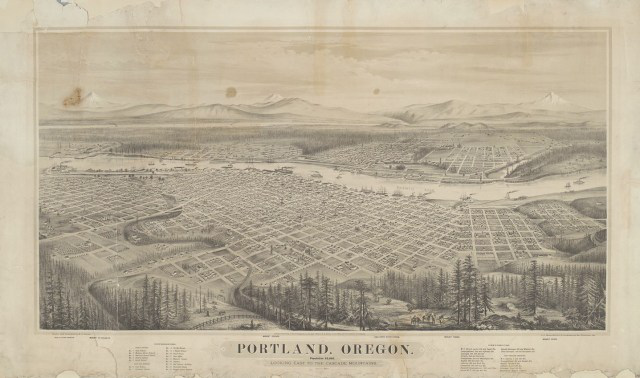
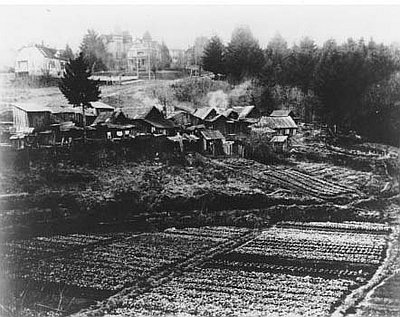
历史、生态和文化的边界 The margins of history, ecology, and culture overlap in stories about hidden hydrology. This is evident in a 2016 article by Putsata Reang in Oregon Humanities, entitled ‘The Farmers of Tanner Creek’ that looks at this convergence in Portland and the history in the Goose Hollow area to the southwest of downtown.历史、生态和文化的边界重叠于有关隐藏水文的故事中。这点在俄勒冈人文学科的Putsata Reang写于2016年的一篇题为“坦纳溪的农民”的文章中相当明显,该文章着眼于波特兰市的这种(历史、生态和文化的)融合以及城市西南鹅谷地区的历史。The article investigates the shadow economy of Chinese immigrants that gardened on the fringes of the city of Portland around the turn of the century. Alternatively referenced as “Vegetable Man” or “Chinaman”, Reang leads with the ledgers of the Mills family, who “likely hefted his produce in wicker baskets hung from a pole and slung across his shoulder, trekking uphill from the gulch along Tanner Creek in Southwest Portland where his garden grew and along the hill to the Mills’ mansion every day, faithfully, for much of 1907.”这篇文章调查了世纪之交在波特兰市边缘耕种的中国移民的灰色经济。Reang在文章开头提到,当地著名的米尔斯家族的账本上,中国移民被称为“蔬菜人”或“瓷人”。他们“很可能把他(们)的农产品装在挂在杆子上的柳条筐里,然后斜挎在肩上,从坦纳溪沿岸的峡谷徒步上山。在1907年的大部分时间里,他(们)的菜园每天都在波特兰西南部生长,沿着小山一直到米尔斯的豪宅。”The photo above shows the area around 1892, where “Tanner Creek runs between Chinese gardens and shanties” on what is now the site of Providence Park, where the Portland Timbers soccer team plays.上面的照片显示了1892年左右的鹅谷地区,“坦纳溪在中国菜园和棚户区之间流淌”,现在这里是波特兰伐木工足球队比赛的普罗维登斯公园。The story also notes that around 1910 that these gardens and “vegetable men” started to disappear from life, a combination of urban expansion and racism which made the land more valuable and more likely to lead to displacement. Perhaps something we can learn from again with massive growth and gentrification that is occuring in Portland and many other cities. As Tracy Prince is quoted:“It was real estate that was once undesirable and became desirable that disbanded the vegetable garden community,” says Tracy J. Prince, professor emeritus at Portland State University. “The same pressures are gentrifying Northeast Portland, having the black community move out.”故事还指出,在1910年左右,这些菜园和“蔬菜人”开始从生活中消失,城市扩张和种族主义的结合使土地更有价值,也更有可能导致流离失所。随着目前的波特兰和许多其他城市发生大规模增长和高档化,也许我们可以再次从中学到一些东西。正如波特兰州立大学名誉教授Tracy Prince所说:“正是房地产开发在这里曾经不受欢迎,后来变得受欢迎,才使得菜园社区分崩离析。”“同样的压力正在使波特兰东北部高档化,导致黑人社区搬出。”The draw for Chinese immigrants to the area may have been the location adjacent to the creek, which Reang mentions “the lure of that wild land and an interest in cultivating crops that many had brought from their homes in the agrarian Pearl River Delta of China, an area known for terraced farming,”吸引中国移民到该地区的可能是靠近小溪的地理位置,就像Reang提到的那样,因为“那片荒地的诱惑和对种植农作物的兴趣——许多人从中国珠江三角洲(一个以梯田农业而闻名的地区)的老家带来的农作物,”The land was considered less desirable by settlers, but for immigrants aligned with floodplain food production, using the rich soils to maximize yields. The first removal of the natural channel of Tanner Creek was also the reason for the gardens to exist:美洲殖民者认为这片土地不太理想,但对于有洪泛区粮食生产经验的移民来说,他们可以利用肥沃的土壤来最大限度地提高产量。坦纳溪天然河道的首次移除也是菜园存在的原因:“When a wooden bridge over the creek that connected the burgeoning neighborhoods from 14th Street to 17th Avenue North collapsed during a flood in 1873, the city used the calamity as an opportunity not only to repair the bridge, but also to tame Tanner Creek. That summer, the City of Portland contracted Chinese workers to build a 115-foot cylindrical culvert to pipe the creek sixty feet below Burnside Street, a solution that both controlled and ultimately prevented flooding in the area.”“当连接从第14街到第17大道北的新兴社区的一座木桥在1873年的一场洪水中倒塌时,这座城市利用这场灾难作为一个机会:不仅要修复这座桥,还要驯服坦纳溪。那年夏天,波特兰市与中国工人签订合同,建造一个115英尺长的圆柱形涵洞,在伯恩赛德街下方60英尺为小溪铺设管道,这一解决方案既控制了又最终防止了该地区的洪水。”
危机
The workers stayed and cultivated the areas, eventually growing on 20 acres of land, with many gardeners avoiding the perils of other urban jobs and selling their produce to local residents, many who employed Chinese cooks, according to the article. While the land was undesirable, there was no issue, even without ownership, to using it for production. The dark history of racism in Portland started early, as mentioned, and this was directed specifically at Chinese, as “Oregon’s state constitution of 1859 barred anyone of Chinese descent from owning property, which meant that the Chinese gardeners could be evicted from their farms at any moment.”文章称,工人们留下来开垦这片地区,最终在20英亩的土地上耕种,许多园丁避免了其他城市工作的危险,并将他们的产品卖给当地居民,其中许多人雇用了中国厨师。当这是片不受(房地产开发商)欢迎的土地时,即使园丁们没有所有权,也能将其用于生产。如前所述,波特兰的种族主义黑暗历史很早就开始了,这专门针对中国人,因为“俄勒冈州1859年的州宪法禁止任何华裔拥有财产,这意味着中国园丁随时可能被赶出他们的农场。”Eventually expansion and development led to the demise of both Tanner Creek and the gardeners that capitalized on the floodplains, land was taken for building the Multnomah Athletic Club in 1893, moving gardeners south, until eventually they were move out completely, as populations spiked around the turn of the century.最终,扩张和发展导致坦纳溪和利用洪泛平原的园丁的消亡。因为世纪之交的人口激增,1893年,土地被用于建造摩特诺玛运动俱乐部,迫使园丁向南迁移,直到最终他们完全搬出。
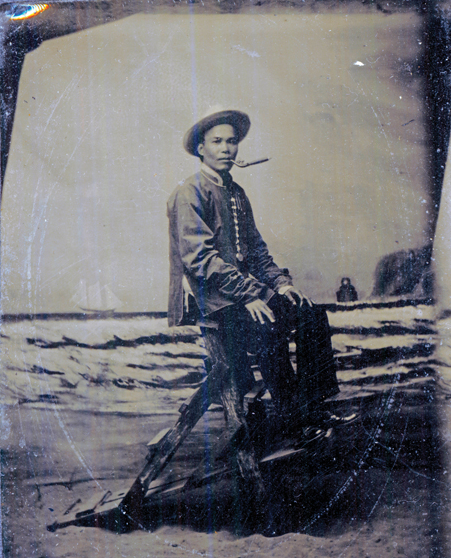
不平等条例Ironically for a town that prides itself on food carts, the other mechanism, the adoption of policies limiting street vending – as the article mentions, quoting Marie Rose Wong, who wrote about the Chinese gardens in her book, Sweet Cakes, Long Journey: “In 1897, the Portland Common Council adopted an ordinance requiring street vendors within city limits to obtain a license—a move that angered white owners of several fish companies that were affected by the law. The white business owners protested and by 1910, the city adopted an additional ordinance limiting the area of downtown where street peddlers could sell their wares to an area that effectively covered most of downtown Portland. Those who sold meats, fish, ice, bread, and newspapers were exempted from the ordinance, which effectively banned only the Chinese vegetable peddlers from operating.”具有讽刺意味的是,对于一个以食品推车为荣的城镇来说,另一种排华机制是采取限制街头贩卖的政策——正如文章所提到的,引用Marie Rose Wong的话,她在她的书《甜蜜的蛋糕,漫长的旅程》中写到了中国菜园:“1897年,波特兰共同委员会通过了一项法令,要求城市范围内的街头小贩获得许可证——此举激怒了几家受法律影响的鱼类公司的白人企业主。白人企业主进行抗议,于是到1910年,该市通过了一项附加条例,限制街头小贩将商品出售到覆盖了波特兰市中心大部分地区的区域。那些卖肉、鱼、冰、面包和报纸的人不受该条例的约束,该条例实际上只禁止中国蔬菜小贩经营。” 斗争The crux of the story is that there are hidden stories of people embedded in the narratives of hidden hydrology, in this case the fates of Tanner Creek intertwined with those that helped to literally build grow Portland, attempting to use the creek to cultivate a life amidst forces of racism and development.故事的关键在于隐藏的水文叙述中嵌入了人们隐藏的故事。在这种情况下,坦纳溪的命运与那些帮助真正建立波特兰的人的命运交织在一起,他们试图在种族主义和发展的力量下利用小溪培植生活。A tintype depicts a Chinese cook named Ho posing on the corner of Sixth Street and Ankeny Street in Portland, circa 1870. Photo by JW Applegate, courtesy of Gholston Collection一张锡板照片显示了一位名叫何的中国厨师在波特兰第六街和安克尼街的拐角处摆拍,时间大约是1870年。照片由JW Applegate拍摄,由Gholston Collection提供 历史存在的层次The article is a great reminder of the layers of history that exist, from native peoples that occupied spaces these places prior to European settlement, as well as the diversity of those, many often overlooked in white washed histories, that contributed to the early life of these cities, and continue to contribute today. It also is a tale about development, and marginal spaces that seem worthless until pressures make them desirable, and that impulse to remove impediments to development.这篇文章很好地提醒我们历史存在的层次——在欧洲定居之前占据这些地方的土著人民,以及那些在被洗白的历史中经常被忽视的多样性——它们对这些城市早期的生活做出了贡献,并在今天继续做出贡献。这也是一个关于发展的故事,以及在压力使它们变得可取之前似乎毫无价值的边缘空间的故事,以及消除发展障碍的推动力的故事。A great additional narrative of Goose Hollow, and where I remember first seeing these images of farms, is the book “Portland’s Goose Hollow” by Prince, worthy of a good summary on the site as well, as it does unlock some mysteries about “how Goose Hollow got its name and how Tanner Creek Gulch was filled.” Another photo from the Oregon Encyclopedia history of Goose Hollow shows a slightly different view, capturing the view, circa 1890s, of the creek running under the trestle bridge, with the Chinese vegetable gardens in the lowlands and Portland High School in the distance.关于鹅谷的一个很好的补充叙述,也是我第一次看到这些农场图片的地方,是普林斯的书《波特兰的鹅谷》,也值得做一个好的总结,因为它确实解开了一些关于“鹅谷如何得到它的名字,以及坦纳溪峡谷如何被填满”的疑问。另一张来自俄勒冈百科全书鹅谷历史的照片展示了一个稍微不同的视角,拍摄了大约1890年代在栈桥下流淌的小溪,低地的中国菜园和远处的波特兰高中。 Another from the same source shows the Chinese truck gardens sprawling around Tanner Creek Gulch a bit earlier, from the 1880s.来自同一来源的另一幅画展示了1880年代在坦纳溪峡谷周围蔓延的中国商用菜园。
Many thanks to my Portland friend and hidden hydrology contributor Matt Burlin for this link.非常感谢我的波特兰朋友和隐藏水文的撰稿人Matt Burlin提供此链接。 原文作者:Jason King翻译:张喆茗